
Why Companies Choose Inlog
The business case, in the language the decision gets made in.
Automation is approved on a business case, not on a specification sheet. The eight outcomes below are what operators are actually buying, and each one is measurable against the numbers your operation already reports.
-
01
Faster ROI
Return on investment is calculated with you during the assessment, before anything is quoted. Phased deployment means the first phase starts returning while later phases are still being planned, rather than payback beginning only after a full cutover.
-
02
Lower labor dependency
Goods-to-person picking, automated transport, and automated sortation remove the roles that are hardest to staff. The same headcount covers more volume, and the schedule stops depending on who showed up.
-
03
Higher order accuracy
Verification is a system gate rather than an operator habit. Items are re-scanned and compared against order data before packing, and every order carries a time-stamped visual record.
-
04
Increased throughput
Retrieval time stops depending on where a SKU sits, and order release runs continuously instead of in waves. Throughput scales with station count rather than with floor space.
-
05
Improved inventory visibility
Every tote is tracked in real time, cycle counting runs continuously instead of shutting the floor down, and stock position is exposed to your WMS and ERP as it changes.
-
06
Better equipment utilization
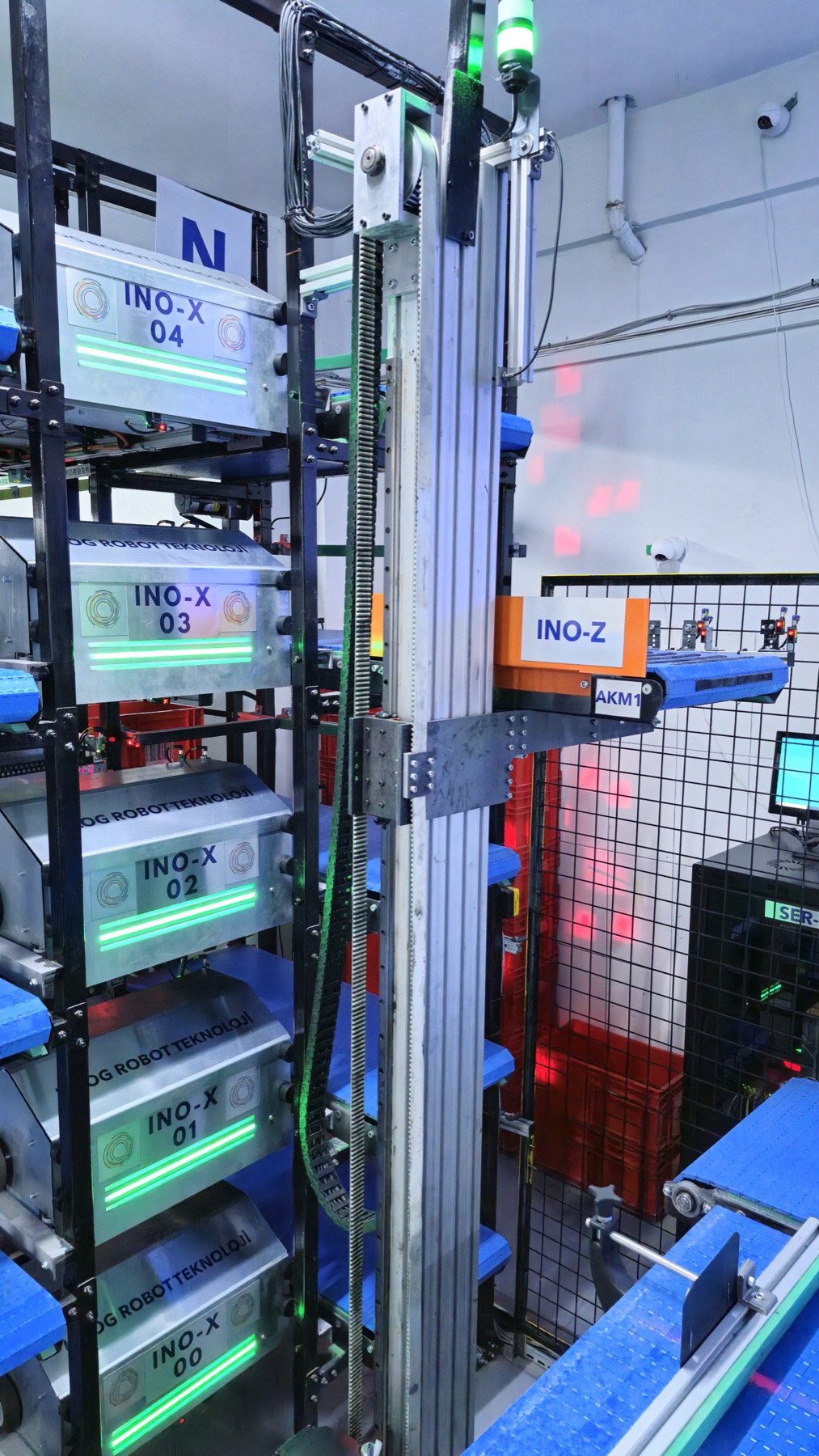
Fleet management balances load across shuttles and lifts, and SCADA monitoring reports uptime and duty cycle per unit — so utilization is a number you manage rather than an assumption.
-
07
Reduced operational bottlenecks
Flow between storage, picking, packing, and outbound is synchronized by one control layer, so downstream stations are fed at the rate they can absorb instead of being buried at peak.
-
08
Scalable automation
The same control architecture runs a single-aisle pilot and a multi-site deployment. Capacity is added in increments of aisles, levels, stations, and lanes as volume justifies it.
Each of these is checked against your measured baseline during assessment, then reported live once the system is running — see how each metric is established.